Craft Stories · Uttar Pradesh · 9 min read
The Loom of Gods: Inside Varanasi's Sacred Banarasi Weaving Tradition
Where silk threads become scripture and every sari is a meditation on eternity
Where silk threads become scripture and every sari is a meditation on eternity
Before the city has found its voice, before the Ganges catches its first gold, the handloom is already speaking. In the cramped upper rooms of Varanasi's old weaving quarters — in Madanpura, in Lallapura, in the ancient lanes folded into the city like a prayer — a man sits before a structure of wood and thread that his grandfather also sat before. The silk is cold against his fingers. The shuttle moves. The morning begins, as it has begun here for three thousand years.
Varanasi is the oldest continuously inhabited city on earth. It has been many things — a seat of learning, a place of pilgrimage, a city where Hindus come to die and be released from the cycle of rebirth. But woven into every epoch of its existence, as surely as the river defines its western edge, is this: the making of silk. The Banarasi sari is not merely a garment. It is evidence — of a civilisation's capacity for beauty, of the transmission of knowledge across generations so unbroken that the techniques described in ancient Sanskrit texts are recognisable in workshops operating today.
The historical record is deep. Weavers of Varanasi are mentioned in the Mahabharata. The city's silk reached the courts of the Maurya emperors. Under Mughal patronage, the craft ascended to its apex: Persian motifs fused with Indian sensibility, gold and silver threads drawn from the imperial treasury into fabric that draped the bodies of queens. Akbar is said to have commissioned Banarasi work for his court. Maratha nobles collected it as currency. When the British arrived and dismantled the patronage networks that had sustained the weavers, the art nearly died — and in its near-death, revealed its own stubbornness. It did not die. It contracted, endured, and survived into a world that had not yet learned to properly value what it had nearly lost.
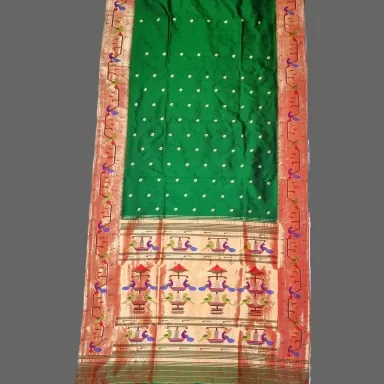
A Banarasi silk sari in full — the zari work catching light in the way no photograph can fully capture. Image: Wikimedia Commons.
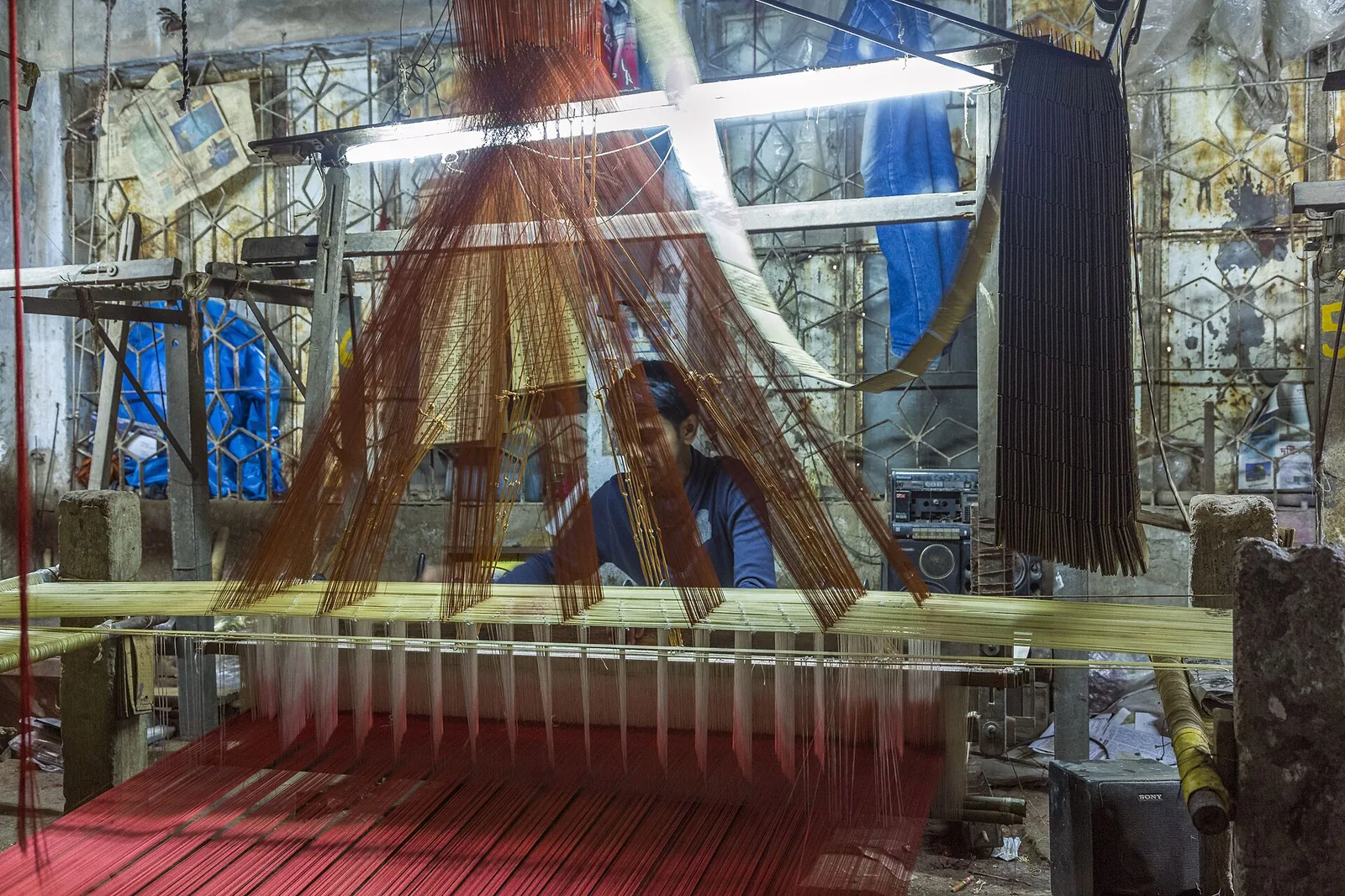
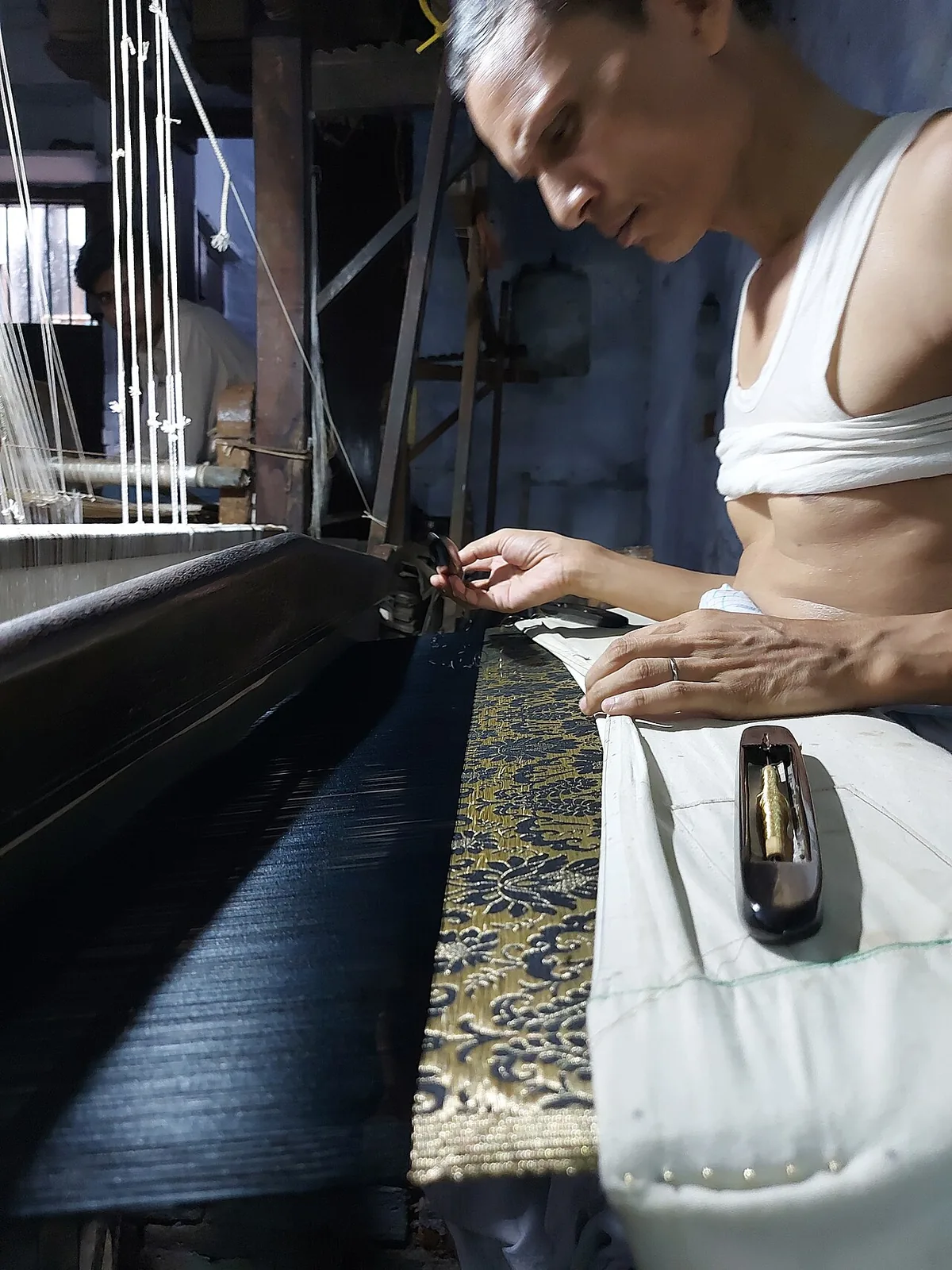
To understand the craft is to understand the loom. The Banarasi handloom is a jacquard loom — a system of punched cards controlling individual warp threads, allowing the weaver to produce patterns of extraordinary complexity. A master weaver works with pure silk threads, hand-feeding the weft across thousands of warp ends, guiding the shuttle through openings so precise that a single error requires unpicking hours of work. The zari — the metallic thread that gives Banarasi its characteristic luminescence — is drawn from bobbins of real gold and silver alloy wire, twisted around a silk core so fine it would be invisible to the naked eye if it were not, impossibly, shining.
There are four principal weave structures, each with its own character and occasion. Katan is pure silk on pure silk: the densest, most formal weave, the one chosen for weddings and ceremonies that demand weight and permanence. Organza — Kora — is diaphanous, almost translucent, a cloth that moves like water and seems to contain its own light. Georgette is the most fluid of the four, its tightly-twisted threads giving the fabric a gentle crepe texture, a softness that drapes rather than falls. And Shattir — the rarest — is woven with a base of cotton threads and a face of silk, a combination that produces a cloth of unusual thickness and a matte lustre entirely its own. Each weave demands different skill, different timing, different hands. A weaver who works in katan has not necessarily mastered shattir.
The question of time is the question that undoes every assumption a buyer might bring to a price. A simple Banarasi sari — one with a modest butis scattered across a plain field, a standard border, a relatively uncomplicated pallu — takes fifteen days. A sari in the grand tradition, with a jangla ground so dense that every centimetre of the fabric is covered in interlocking leaves and flowers, with a shikargah pallu depicting a hunting scene complete with elephants, horses, and courtly figures in full procession — this takes six months. The weaver and his assistant sit at the loom for twelve hours a day. They do not rush. Rushing is structurally impossible: each pass of the shuttle is a decision.
"A Banarasi sari is not worn — it is inherited. It passes from grandmother to granddaughter like a whispered prayer."
The motifs are a library. Butidar — the scattered floral pattern, a single flowering stem or stylised blossom repeated across the field — is the most democratic, the most versatile, the one that appears in a thousand variations from modest to extravagant. Jangla is its antithesis: no ground is visible, every thread of the base fabric hidden beneath a forest of leaves, vines, and flowers so dense it seems to breathe. Shikargah — the hunting ground — is the most narrative of the classic motifs, its origins traceable directly to Mughal miniature painting: emperors on horseback, tigers in flight, the whole pageant of the imperial hunt translated into silk. And meenakari achieves, through the magic of the zari technique, something that ought to be impossible in textile: the effect of enamel work, colours inlaid within the gold like the stones in a jeweller's setting, glowing from within the weave as if the thread itself were alive.
Each motif carries its own weight of meaning. The Mughal garden — that paradise of controlled nature, flowers in ordered rows, water channels and pavilions — is the constant reference point, the dream of beauty that recurs across every style of Banarasi decoration. Alongside it runs the vocabulary of temple architecture: the lotus, the kalash, the dancing figures borrowed from the stone friezes of Varanasi's own ghats. A Banarasi sari is not a passive object. It is a record of everything its city has seen, folded into six yards of silk and gold.
A weaver at work on a jacquard handloom in Varanasi. Image: Wikimedia Commons.
Detail of the zari work — gold and silver wire twisted around silk, thread by thread. Image: Wikimedia Commons.
The crisis is not abstract. It is present and measurable. The powerloom — a mechanised approximation of the handloom that can produce a sari in hours rather than months — has flooded the market with near-copies that the untrained eye cannot distinguish from the genuine article. The difference is felt more than seen: in the weight of the fabric, in the precision of the repeat, in the quality of the zari, in whether the reverse side of the cloth reveals the intelligence of a human hand or the indifference of a machine. Varanasi once had an estimated 1.2 million weavers working on handlooms. The numbers have collapsed. Families that wove for ten generations are sending their children to cities to work in factories, because the income from handloom weaving no longer sustains a life.
The Geographical Indication tag, granted in 2009, was a legal recognition of what every weaver already knew: that a Banarasi sari can only be a Banarasi sari if it comes from this city, made by these hands, using these methods. The GI tag protects the name. It does not, by itself, protect the practice. For that, the Bunkar community — the hereditary weaving caste of Varanasi, whose identity is inseparable from the loom — must find buyers who understand what they are buying. The tag is a legal instrument. The survival of the craft depends on something older and more unreliable: taste.
"When you drape a Banarasi, you are wearing three thousand years of unbroken devotion."
There are weavers in Varanasi today who still work the old way — from the design stage, where the pattern is first conceived and then translated into the punched card system of the jacquard, through the warping and dressing of the loom, through the weaving itself, through the finishing. They are not quaint. They are not performing tradition for visitors. They are working, in the same manner their fathers worked, producing objects of a beauty so particular that nothing made by machine can approach it. They know this. It is not pride — it is simply a fact about the nature of their skill.
At Morassa, we travel to these workshops. We sit with the weavers. We watch the shuttle move. We handle the cloth before and after, learning through our fingers what no photograph can teach. The pieces we bring to you are not reproductions of a tradition — they are the tradition itself, taken directly from the loom to your home. A Banarasi sari from Morassa is a living object, carrying with it the specific time and the specific hands that made it. In a world of copies, that specificity is everything.
Be among the first to own a piece of Banarasi silk, woven by master artisans on the handlooms of Varanasi.
Join the Waitlist