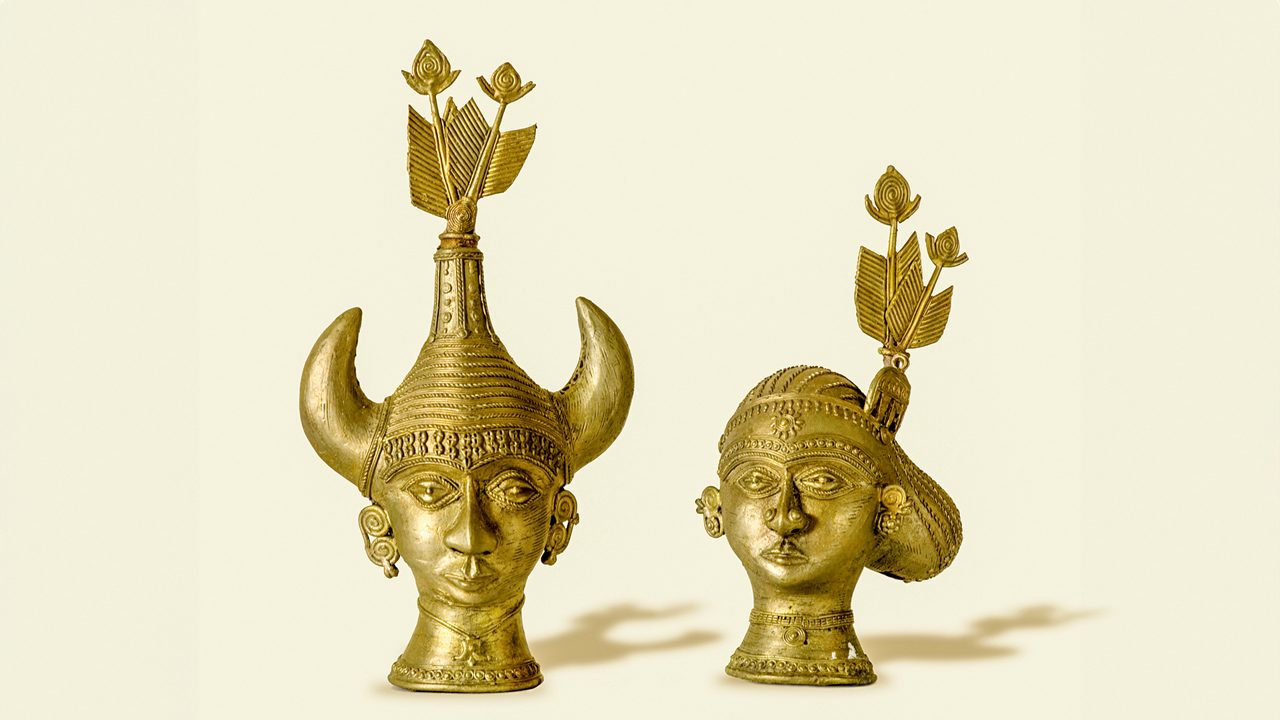
Metal Craft · West Bengal · 5 min read
Cast Once, Never Again: The Ancient Magic of Dhokra
A method four thousand years old. A process that cannot be undone.
A method four thousand years old. A process that cannot be undone.
The mould is packed in clay, dried in the sun, and fired in an open kiln. Then comes the molten brass — poured in one decisive movement through a small opening at the top. The artisan does not hesitate. He cannot. Dhokra casting allows no second thoughts. The metal flows where the wax once was, filling every curve, every detail the sculptor spent days carving. When the clay is broken away hours later, what emerges has never existed before — and will never exist again in quite the same form.
This is the lost-wax casting process, known in Sanskrit as Madhuchhistha Vidhana — and it is, without exaggeration, one of the oldest continuously practiced metal-casting techniques on earth. The famous Dancing Girl of Mohenjo-daro, cast in bronze roughly four thousand years ago, was made using this exact method. The artisans of Bankura, Bastar, and Odisha who practice Dhokra today are not imitating an ancient tradition. They are continuing it, unbroken, across four millennia.
"Each piece is broken out of its mould — cast once, never again. There is no second casting. No correction. Only the object, and the decision that made it."
The process begins not with metal but with beeswax and resin — gathered, softened, and rolled into fine threads by hand. These wax threads are then wound, pressed, and sculpted around a clay core to form the desired shape: a horse, a deity, a woman carrying a water pot, an elephant in ceremonial dress. The detail at this stage is everything. The wax must carry every mark the finished brass piece will carry, because the casting process is a perfect negative — what the wax holds, the metal will hold.
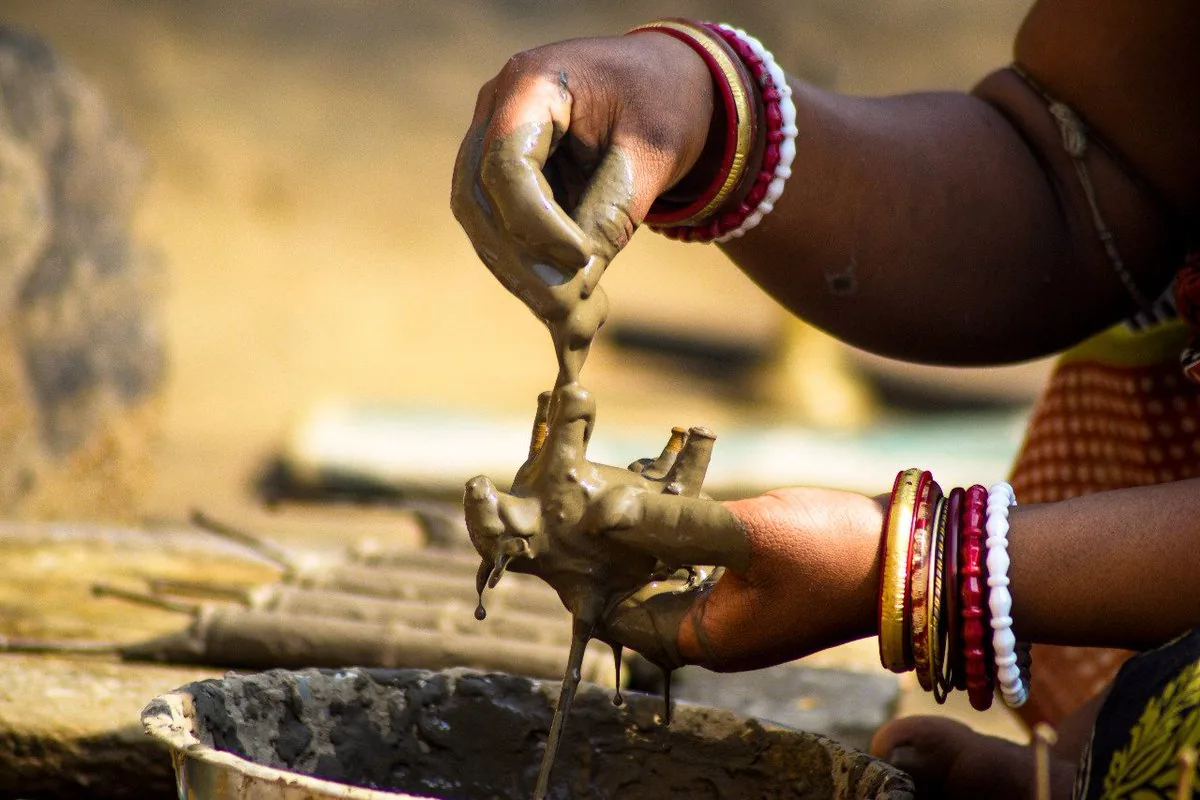
A Dharua tribal woman making a Dhokra cast. The wax model takes days; the casting takes minutes; the result lasts centuries. Image: Wikimedia Commons.
Once the wax sculpture is complete, it is encased in layers of clay — river clay mixed with sand, cow dung, and rice husks to manage the thermal shock of the firing. Channels are left open for the metal to enter and for the wax to escape. Then the whole assembly goes into the kiln. The wax melts and drains away — hence "lost wax" — and in its absence, a perfect hollow cavity remains. The molten brass, an alloy of copper, zinc, and tin, follows immediately. The temperature must be precisely right. The pour must be even and uninterrupted. There is no room for hesitation in a craft that operates on the timescale of seconds.
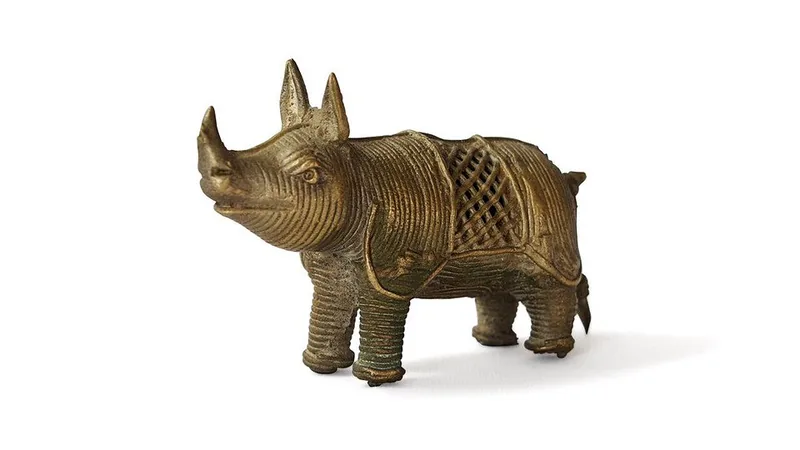
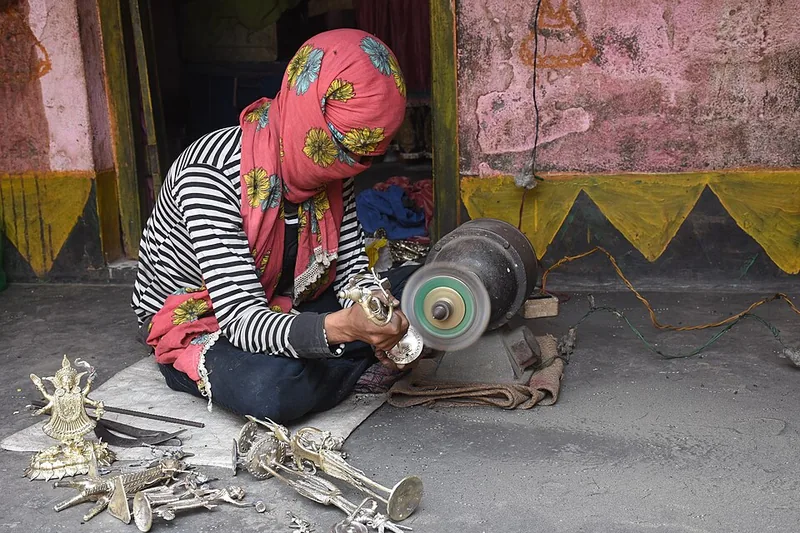
What distinguishes Dhokra from industrial casting — apart from everything — is the surface. Because the wax is hand-formed, the texture of the artist's fingers, the deliberate roughness of the resin threads, the slight irregularities of hand-pressed clay all survive into the final metal. Every Dhokra piece has a topography you can feel with your eyes closed. The surfaces are alive in a way that no machine-cast object ever achieves. This is not a flaw in the process. It is the point of it.
"The surface of a Dhokra piece carries the fingerprints of the person who made it — translated into brass, preserved for generations."
The motifs of Dhokra are drawn from the natural world and from tribal mythology: horses and elephants, the sun and moon, goddesses and hunters, fish and birds. They speak of a relationship between human beings and their environment that industrial society has largely forgotten. To bring a Dhokra piece into a contemporary home is not merely to acquire an object of beauty — it is to admit something ancient into your living space. Something that remembers a time before mass production, before the idea that objects should be identical, before the belief that speed is a virtue.
At Morassa, we work directly with Dhokra masters from West Bengal and Bastar — communities where the craft is still practiced as a living tradition, not a tourist performance. Each piece we source has been cast by hand, broken from its clay mould, and finished by the same artisan who conceived it. No two pieces in our collection are identical. That is not a policy. It is a physical impossibility.
Own a piece of Dhokra — cast once, never again, directly from the masters of West Bengal.
Join the Waitlist