Tribal Painting · Madhya Pradesh · 5 min read
The Forest Speaks: Gond Art and the Language of Nature
Not decoration. Not illustration. A worldview, pressed dot by dot into existence.
Not decoration. Not illustration. A worldview, pressed dot by dot into existence.
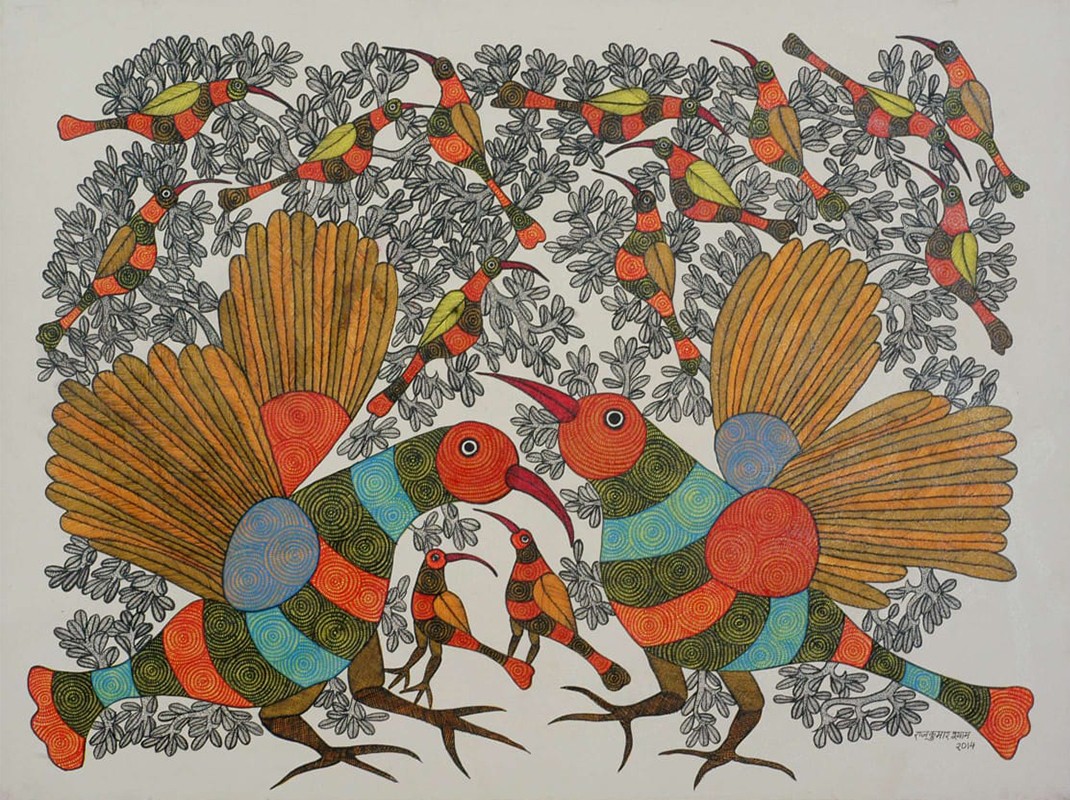
Look closely at a Gond painting — closer than you think you need to. What appears from a distance to be a solid field of colour resolves, as you approach, into an extraordinary density of tiny marks: dots, dashes, lines, curves, all interlocked in patterns that fill every centimetre of the surface without leaving a single millimetre of empty space. There is no background in Gond painting. There is no negative space. Every part of the picture is equally present, equally alive. This is not a stylistic choice. It is a statement about the world.
The Gond people of Madhya Pradesh — one of the largest tribal communities in India — have been painting their world for at least a thousand years. Originally, the paintings were made on the walls and floors of homes, particularly during festivals and ceremonies. The earth pigments — red from stone, white from rice paste, yellow from flowers, black from soot — were mixed fresh and applied by hand and twig. The images depicted the forest, because the forest was everything: source of food, medicine, shelter, spirit. The tiger was power. The peacock was rain. The fish was abundance. Every creature carried a meaning that the community understood without explanation.
"In Gond art, there is no background and no negative space. Every centimetre of the surface is occupied. This is not aesthetics — it is philosophy."
The transition to paper and canvas came in the 1980s, when the artist Jangarh Singh Shyam — now recognised as the father of contemporary Gond art — was invited by the Bharat Bhavan arts centre in Bhopal to paint on paper. What Jangarh produced was revelatory: the dense, intricate surface patterns of traditional Gond wall painting, translated into a portable, collectible, exhibitable form, but without losing a single grain of their original intensity. The dots and dashes that had covered mud walls for centuries now filled galleries in Bhopal, Delhi, and eventually Tokyo and New York.
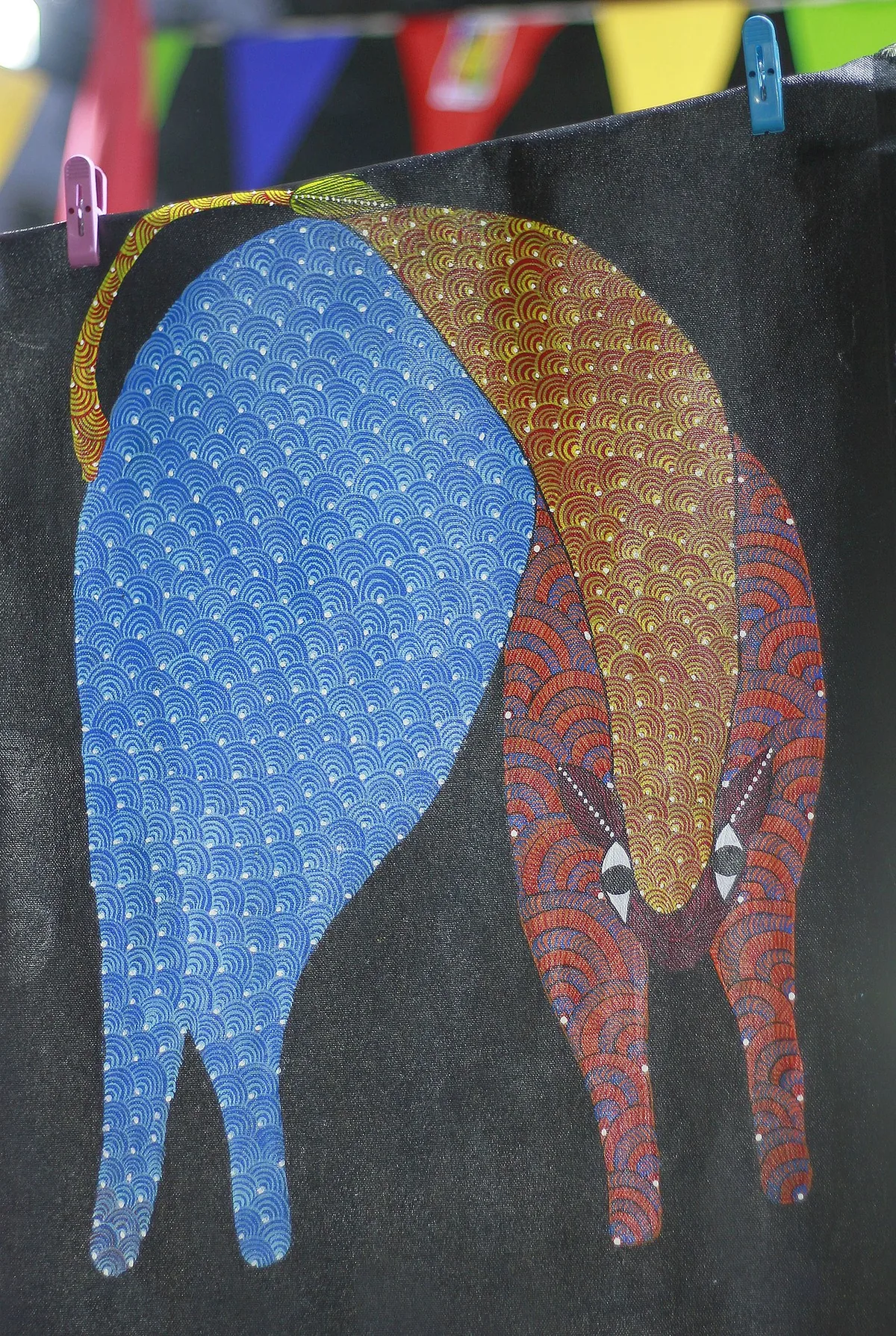
Gond art from Madhya Pradesh — every centimetre of surface occupied, every creature filled with its own inner energy. Image: Wikimedia Commons.
What makes Gond painting philosophically distinct from most art traditions is its relationship to the natural world. In the Western tradition, a painting of a tiger is a representation — an image of something that exists elsewhere, captured and held still. In the Gond tradition, a painting of a tiger is the tiger — or rather, it is a conversation with the tiger's spirit, an acknowledgement of the animal's power and a request for its goodwill. The painting is not a record. It is a relationship. The dots that fill the animal's body are not texture for its own sake — they are the energy of the creature made visible, its inner life given form through the patient accumulation of marks.
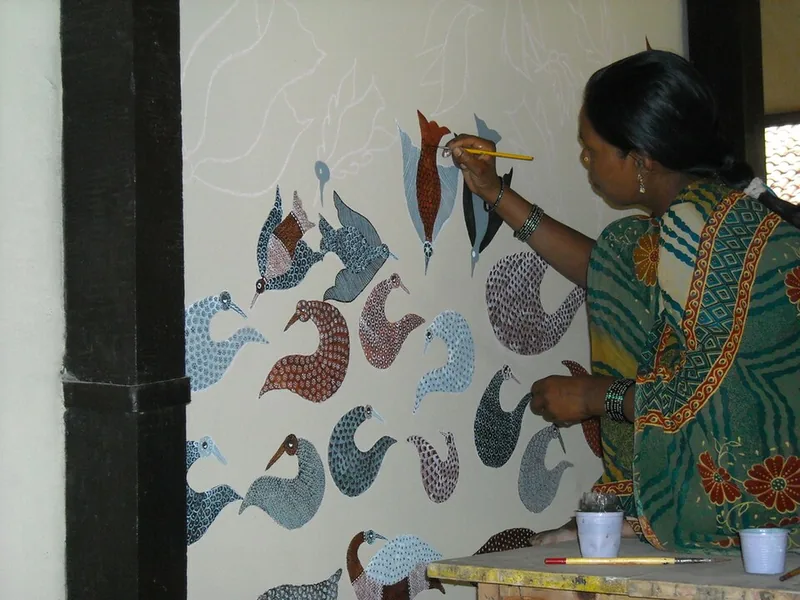
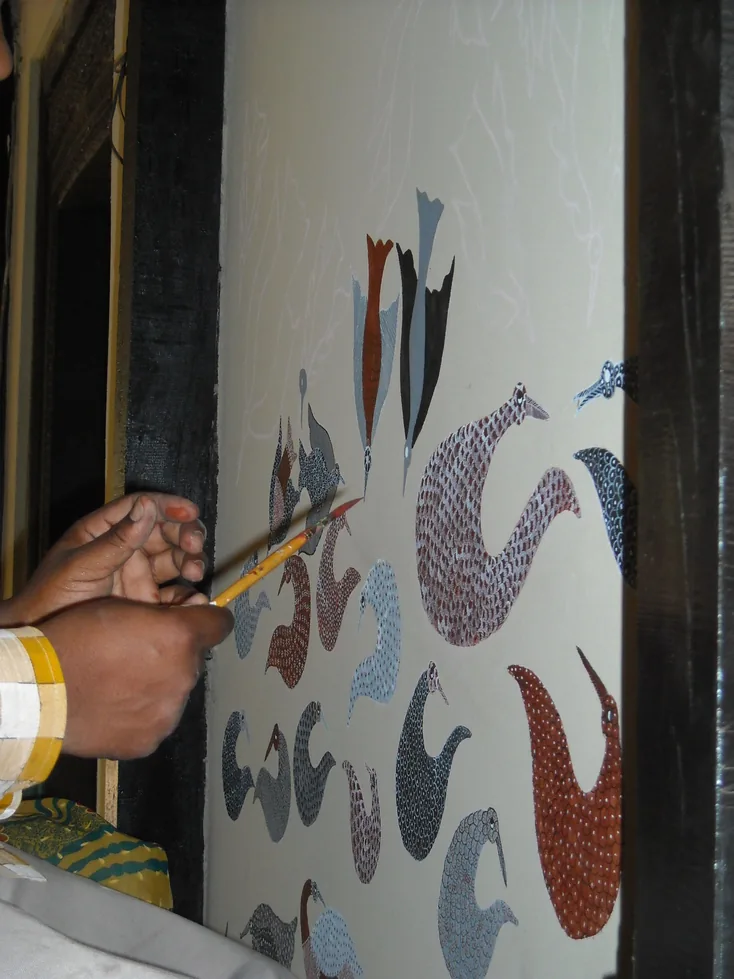
The compositions are almost always centred on a single creature or tree — a peacock, a fish, a banyan — surrounded by other elements of the forest ecosystem. The scale relationships are not realistic. A fish may be as large as a tree. A bird may carry a village on its back. This is not naivety. It is a different understanding of importance — one in which the emotional or spiritual significance of an element determines its size, not its physical dimensions. The Gond artist paints what matters, in proportion to how much it matters.
"A Gond painting of a tiger is not a representation of power — it is a conversation with it. The dots are not texture. They are the creature's inner life made visible."
In a contemporary interior, a Gond painting does something unusual: it slows time. The density of the surface demands attention that cannot be given quickly. You find yourself pulled closer, discovering new details — a hidden bird inside a leaf pattern, a row of fish running along the border of a tree's bark, a human figure so small it almost disappears into the animal it accompanies. Each viewing reveals something the last viewing missed. This is the opposite of decoration, which is designed to be understood at a glance. Gond painting is designed to be inexhaustible.
Morassa works directly with Gond artists from Madhya Pradesh — the heartland of this tradition — ensuring that every piece we source comes from a practitioner who has grown up inside the tradition, not merely learned to replicate its surface. Each painting is accompanied by the name of the artist and the story of the image — because in Gond art, the story is inseparable from the object.
Bring a Gond painting into your home — a forest that will reveal itself to you differently every time you look.
Join the Waitlist