Textile Painting · Andhra Pradesh · 9 min read
The Painted Cloth: Kalamkari and the Art of Storytelling on Fabric
Where a bamboo pen, vegetable dyes, and three thousand years of mythology meet on a single piece of cotton
Where a bamboo pen, vegetable dyes, and three thousand years of mythology meet on a single piece of cotton
The word itself is a map of the craft. Kalam — the pen. Kari — work. Penwork. In the temple town of Sri Kalahasti, in the dry, sun-bleached interior of Andhra Pradesh where the Swarnamukhi river curls past the base of a sacred hill, men and women sit cross-legged on the floor with lengths of raw cotton spread before them and bamboo pens sharpened to a point fine enough to draw a single eyelash on the face of a god. They dip the pen into a dye made from fermented jaggery, water, and rusted iron. The liquid is black. The cloth is white. And between these two absolutes — the darkness of the ink and the blankness of the fabric — an entire civilisation’s mythology unfolds, scene by scene, figure by figure, in a tradition that has not changed its essential method in over three thousand years.
Kalamkari is among the oldest textile arts on earth. Archaeological evidence places its origins in the Indus Valley, where fragments of painted and printed cloth have been recovered from sites dating to the third millennium BCE. The craft as it is practised today descends from two distinct traditions, each named for the town that sustains it. Sri Kalahasti Kalamkari is the freehand tradition — every line drawn by the artist’s hand with the bamboo pen, every colour applied individually, the entire composition conceived and executed without the aid of blocks, stencils, or mechanical repetition. Machilipatnam Kalamkari, from the coastal port town two hundred kilometres to the east, uses hand-carved wooden blocks to print the design, reserving the pen for fine details and outlines. Both are Kalamkari. Both are ancient. But the distinction matters: Sri Kalahasti is painting; Machilipatnam is printing. The difference is the difference between a manuscript and a book.
The process is a study in patience and chemistry. The raw cotton must first be treated — soaked in a solution of cow dung and bleach derived from the myrobalan fruit, then washed, dried, and treated again. This is not ritual for its own sake. The myrobalan acts as a mordant, opening the fibres of the cotton so they will accept and hold the vegetable dyes permanently. Without this preparation, which takes several days, the colours would wash out in the first rain. The fabric must be worthy of the image before the image can begin.
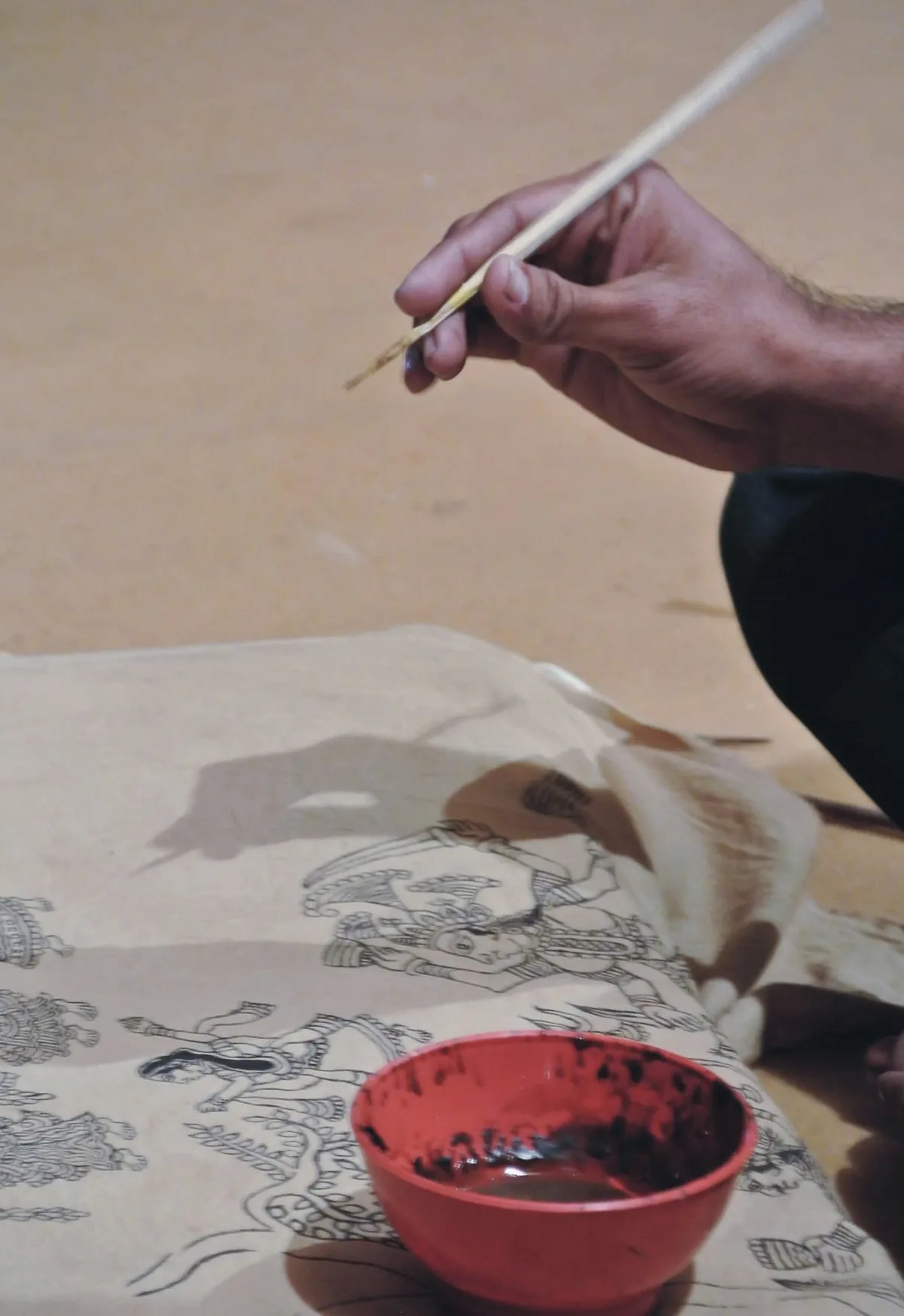
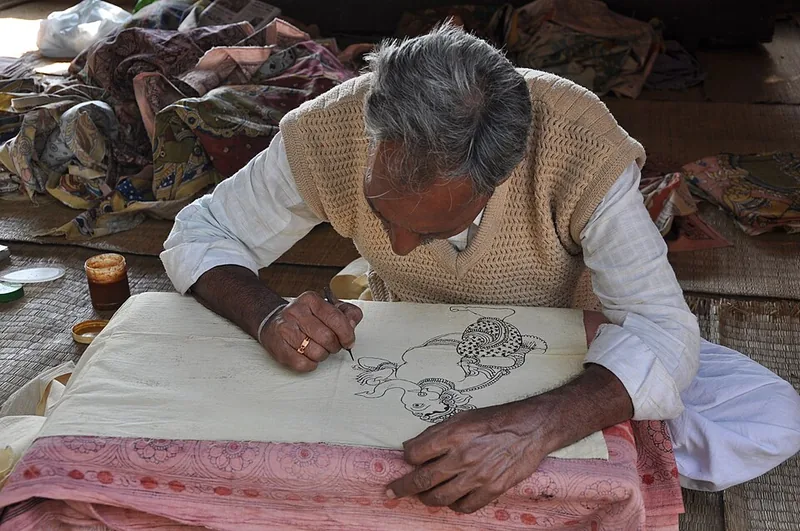
A Kalamkari artist at work in Sri Kalahasti — the bamboo pen, called a kalam, is the only tool between imagination and cloth. Image: Wikimedia Commons.
The colours are drawn entirely from the natural world. Black comes from rusted iron filings fermented in jaggery water for weeks until the liquid turns the colour of old ink. Red is extracted from the root of the Rubia tinctorum plant, the same madder root that has dyed cloth across Asia and Europe for millennia. Yellow comes from pomegranate rind or dried myrobalan flowers. Blue — the most precious and temperamental of the palette — is indigo, prepared from the leaves of the Indigofera tinctoria plant through a fermentation process so particular that a single miscalculation in temperature or timing can ruin an entire vat. Green does not exist as a dye; it is achieved by overdyeing yellow with indigo. Every colour requires its own mordant, its own number of washes, its own drying time. A single Kalamkari painting may be washed and dried between fifteen and twenty times before it is complete.
The subjects of Sri Kalahasti Kalamkari are drawn almost exclusively from Hindu mythology. The great epics — the Ramayana and the Mahabharata — are the primary source texts, their scenes rendered in a visual language that owes as much to the carved friezes of South Indian temples as it does to any painterly tradition. Rama and Sita, Krishna and Arjuna, the Dashavatara of Vishnu, the cosmic dance of Shiva — these figures appear again and again, framed by borders of lotuses and scrolling vines, their faces drawn in the distinctive Kalamkari profile: large almond eyes, sharp noses, elaborate crowns, bodies in the sinuous tribhanga pose borrowed from classical sculpture. The compositions are not illustrations in the modern sense. They are visual scriptures — objects made for temple use, hung as backdrops behind deities during festivals, offered as devotional gifts, used to narrate sacred stories to audiences who could not read.
“A Kalamkari cloth is not decorated. It is narrated. Every panel is a chapter, every border a frame, every figure a word in a visual language older than writing itself.”
The Machilipatnam tradition tells a different story — literally. When Persian and Arab traders arrived at the Coromandel coast in the medieval period, they encountered Kalamkari cloth and immediately recognised its commercial potential. They commissioned designs suited to their own markets: Persian floral patterns, geometric arabesques, the Tree of Life motif that would become the single most iconic image in the entire Kalamkari repertoire. The block-printing method developed at Machilipatnam was a response to this demand — a way to produce larger quantities of patterned cloth without sacrificing the richness of the vegetable-dye palette. The resulting textiles travelled the Indian Ocean trade routes to Persia, the Ottoman Empire, Southeast Asia, and eventually Europe, where they became objects of intense desire. The very word chintz — from the Hindi chint, meaning spotted or variegated — derives from these Indian painted and printed cottons. When the French and English banned their import in the late seventeenth century, it was not because the fabrics were inferior. It was because they were too good — so beautiful, so colourfast, so durable that they threatened to destroy the domestic textile industries of Europe.
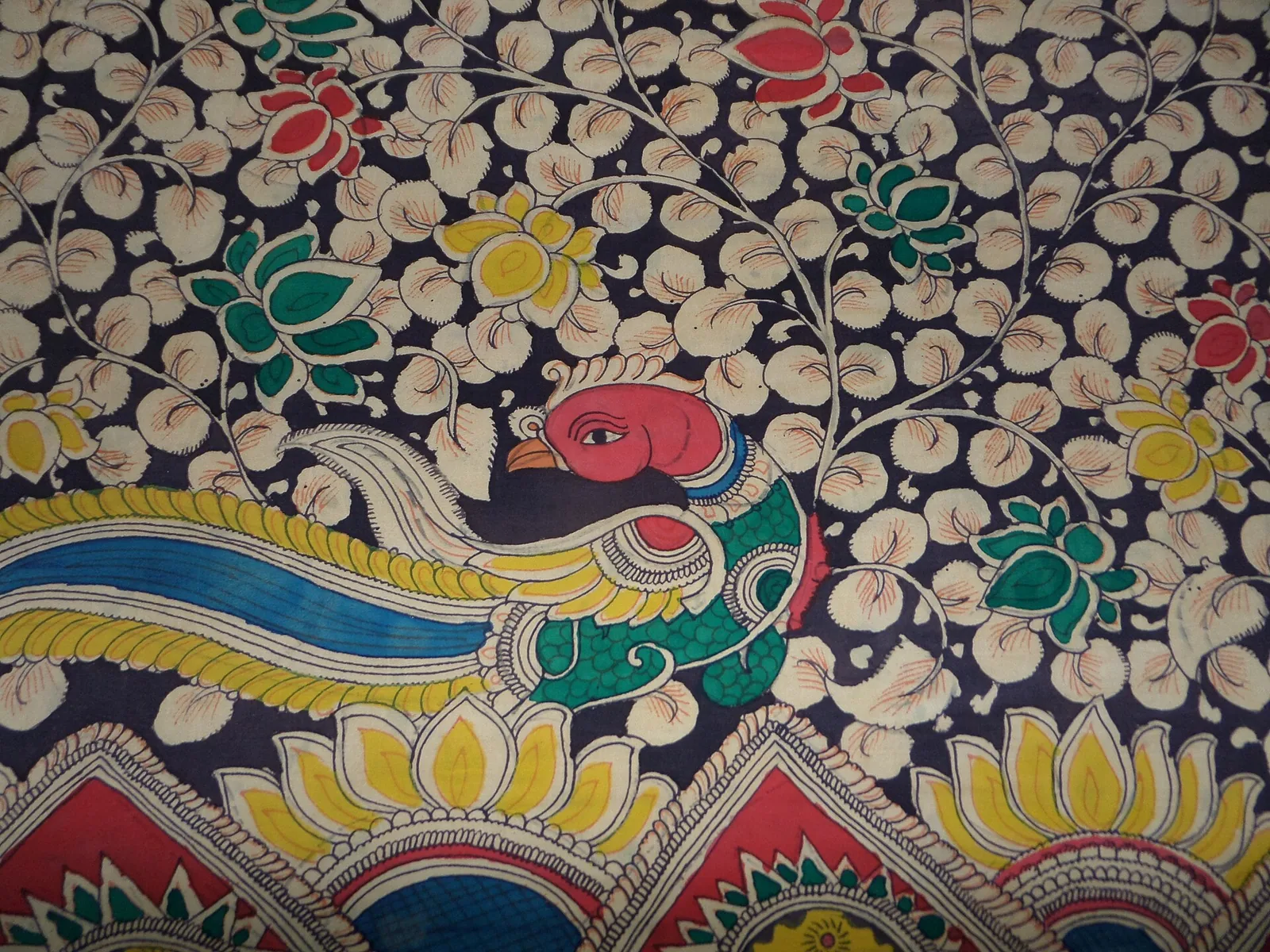
The Tree of Life deserves its own meditation. In Kalamkari, the tree is not merely a decorative motif. It is a cosmological diagram — roots in the underworld, trunk in the mortal realm, branches reaching into heaven, its leaves and flowers sheltering every creature that exists. Birds perch in its upper reaches. Deer and elephants rest in its shade. Serpents coil around its roots. The tree is the axis of the world, the connection between all planes of existence, rendered in vegetable dyes on cotton cloth with a bamboo pen. It is an image that appears in virtually every culture on earth, but nowhere with the specific botanical precision and decorative richness that Kalamkari gives it. A Kalamkari Tree of Life is recognisable at a hundred paces. No other tradition draws trees quite like this.
The Tree of Life — the most iconic motif in Kalamkari, a cosmological diagram rendered on cotton. Image: Wikimedia Commons.
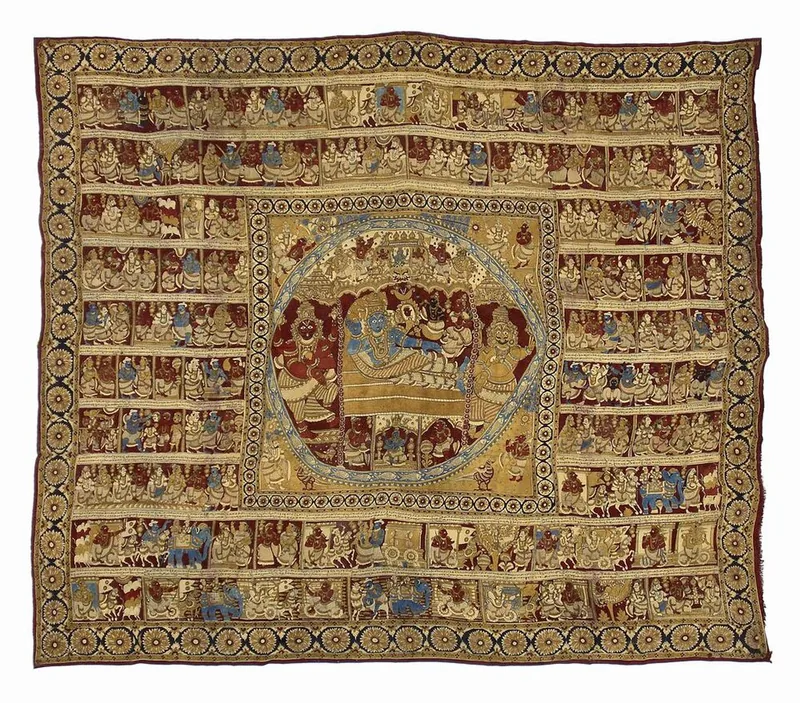
A Kalamkari temple cloth — visual scripture, every panel a chapter from the epics. Image: Wikimedia Commons.
The crisis that faces Kalamkari is the same crisis that faces every handcraft tradition competing with industrial production: speed. A single Kalamkari panel — perhaps one metre by one metre — takes between three weeks and two months to complete, depending on the complexity of the design and the number of colours involved. Each colour requires a separate application and a separate wash. The artist cannot rush. The chemistry of the dyes will not permit it. A synthetic-dye screen print can approximate the visual effect in hours. The difference is invisible in a photograph and unmistakable in person: the depth of the vegetable colours, the slight irregularity of the hand-drawn line, the way the fabric softens with each wash rather than fading, the fact that the reverse side of a Kalamkari cloth is nearly as beautiful as the front — because the dyes penetrate the fibre rather than sitting on the surface.
Yet the tradition endures. In Sri Kalahasti, families that have practised Kalamkari for generations continue to work. The Indian government granted Kalamkari a Geographical Indication tag in 2003, protecting the name and the method. UNESCO and various craft councils have recognised the artists. And a new generation of designers — in fashion, in interiors, in contemporary art — has discovered what the Mughal emperors and Persian merchants knew centuries ago: that there is nothing quite like a piece of cloth on which every mark has been made by a human hand, using colours drawn from the earth, telling a story that is older than the cloth itself.
“The kalam knows only one speed — the speed of the hand that holds it. You cannot rush a line that has taken three thousand years to learn.”
What makes Kalamkari irreplaceable is precisely what makes it slow. The fifteen washes are not inefficiency — they are the method. The bamboo pen is not primitive — it is the instrument that produces a line no metal nib can replicate, flexible enough to swell from a hairline to a broad stroke within a single curve. The vegetable dyes are not a limitation — they are a palette that deepens with age, that responds to light in ways synthetic pigments cannot, that carries within its chemistry the specific soil and water and climate of the Deccan plateau. To mechanise Kalamkari would be to produce something that resembles it. It would not be Kalamkari. The art is inseparable from its process. The process is the art.
At Morassa, we work directly with the Kalamkari artists of Sri Kalahasti and Machilipatnam, bringing their work to you with the full weight of its making intact. Each piece we curate has been washed fifteen times, dyed with roots and rinds and fermented iron, drawn or printed by hands that learned the craft from the generation before. When you hold a Kalamkari cloth from Morassa, you hold a piece of the oldest continuous textile art on earth — and a story that, after three thousand years, is still being told.
Be among the first to own an authentic Kalamkari textile, hand-painted by the master artists of Andhra Pradesh.
Join the Waitlist