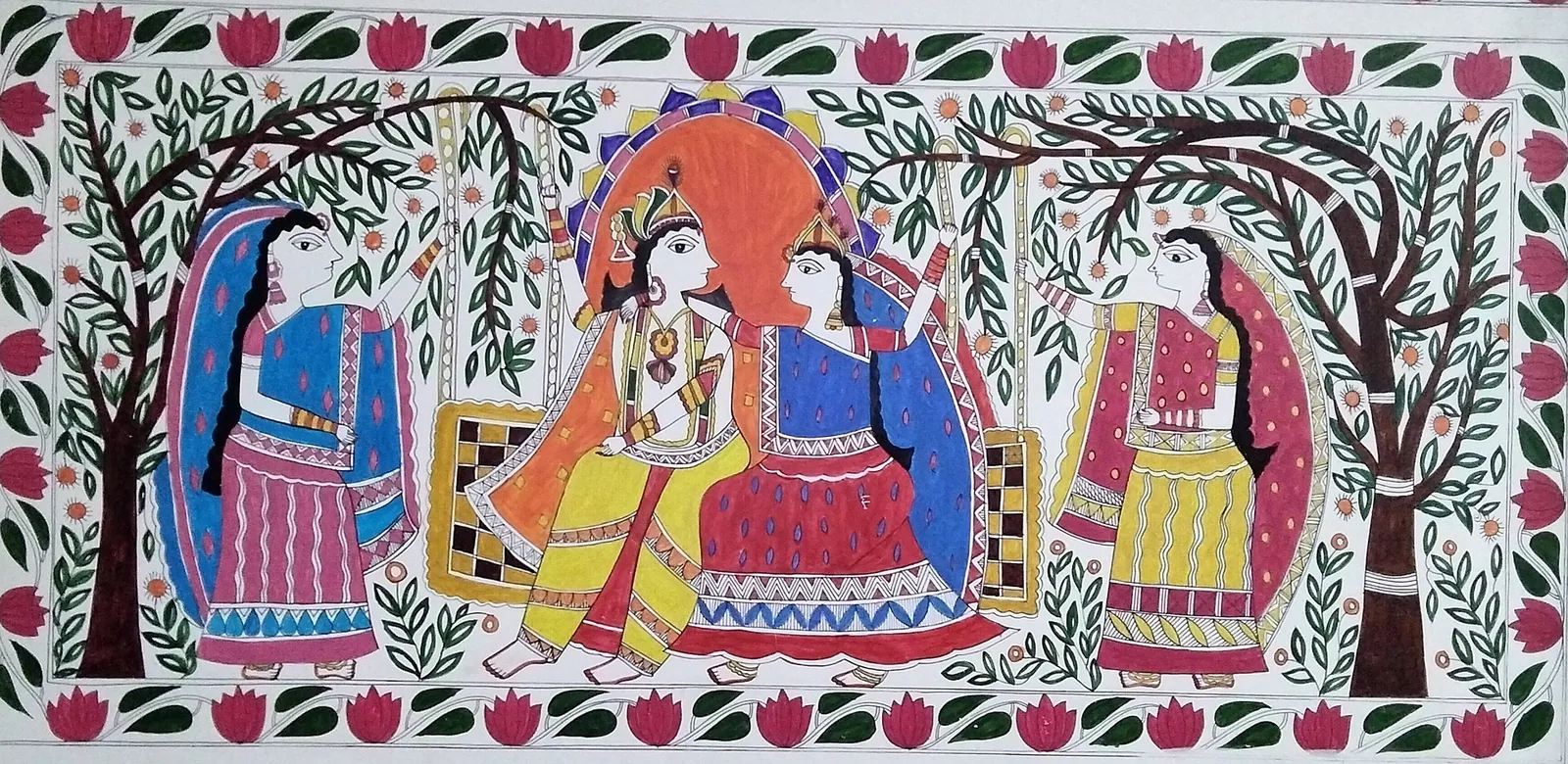
Painting · Bihar · 9 min read
Where the Walls Remember: The Living Tradition of Madhubani Painting
From the mud walls of Mithila to the galleries of the world — an art form that refused to be forgotten
From the mud walls of Mithila to the galleries of the world — an art form that refused to be forgotten
In the villages of the Mithila region, in the flat, flood-prone plains of northern Bihar where the Ganges and its tributaries spread like the veins of an ancient hand, women have been painting their walls for as long as anyone can remember. Not as hobby, not as decoration in the way the word is now diminished, but as ritual — as necessary to the rhythm of the household as cooking rice or drawing water. A daughter is born, and the walls are painted. A wedding is arranged, and the kohbar ghar — the bridal chamber — is covered, floor to ceiling, in images so dense with meaning that every lotus, every fish, every intertwined bamboo grove is a sentence in a language the bride’s mother learned from her own mother, and she from hers, back through centuries so deep they dissolve into myth.
This is Madhubani painting — also called Mithila painting, after the ancient kingdom that once encompassed this land. It is among the oldest continuous art traditions on earth. Its origins are attributed, in local tradition, to King Janaka himself, the father of Sita in the Ramayana, who is said to have commissioned paintings to celebrate his daughter’s marriage to Lord Rama. Whether or not this is historical fact is beside the point. What matters is that the people of Mithila believe it, and have behaved accordingly for millennia — treating the act of painting not as art in the modern, detached sense, but as a sacred obligation, a form of prayer conducted with pigment instead of words.
The materials are elemental. The earliest Madhubani paintings used nothing that could not be gathered from the immediate landscape: black from soot mixed with cow dung, red from kusum flower and sandalwood, yellow from turmeric or pollen, green from the leaves of the wood apple tree, white from rice paste, orange from palash flowers. The brushes were twigs, cotton wrapped around bamboo slivers, or simply the painter’s own fingers. The canvas was the freshly plastered mud wall of the house itself. There was no question of permanence in the Western sense — the monsoon would come, the plaster would crack and wash, and the women would paint again. The impermanence was the point. The act of making was the devotion, not the object made.
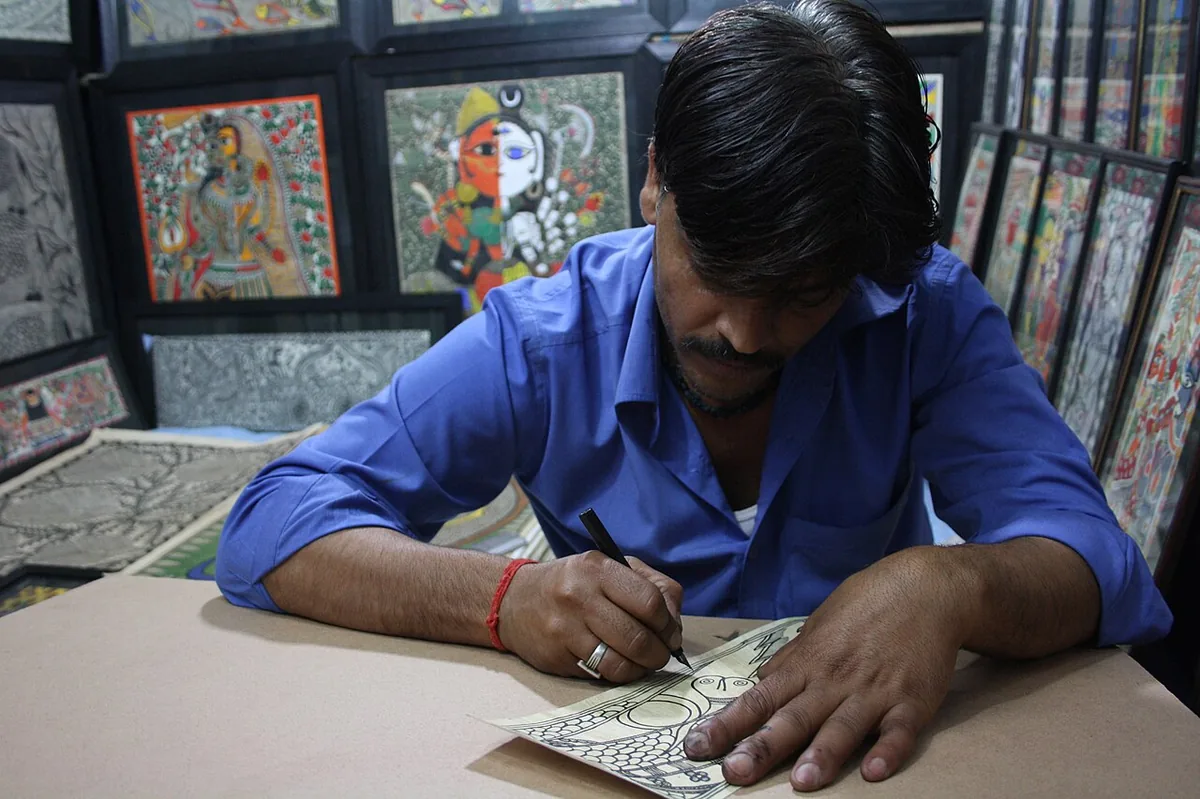
A Madhubani artist at work — the line is drawn freehand, without sketching, guided by memory and muscle. Image: Wikimedia Commons.
The visual grammar is immediately recognisable and utterly distinct. Every Madhubani painting begins with a border — often multiple borders, nested within each other, creating a frame within a frame within a frame, as if the image were being held in place by geometry itself. Within that frame, there is no empty space. This is the cardinal rule of Mithila art: no surface is left unpainted. Every gap between the main figures is filled with flowers, leaves, birds, fish, geometric patterns — a visual density that, to the untrained eye, appears chaotic, but which follows an internal logic as rigorous as any formal composition. The horror of the void, the insistence that every centimetre must speak, gives Madhubani its unmistakable energy — a painting that hums.
There are five distinct styles, each historically associated with a different caste community within the Mithila region. Bharni is the filled style — bold outlines flooded with solid, saturated colour, favoured by the Brahmin women of the upper castes. Kachni is its opposite: fine, hair-thin lines hatched so closely together that they create the illusion of shading, producing images of extraordinary delicacy, traditionally the domain of the Kayastha caste. Tantrik is the most esoteric, its imagery drawn from Tantric cosmology — yantras, mandalas, deities in their fierce and protective aspects, paintings that function as spiritual diagrams. Godna — meaning “tattoo” — belongs to the Dalit communities and replicates on walls the geometric patterns that were traditionally tattooed on the body. And Kohbar, the most ancient, is dedicated exclusively to the bridal chamber: its symbols of fertility and union — the lotus, the fish, the bamboo grove, the parrot — constitute a visual blessing for the newlywed couple.
“In Mithila, a woman who cannot paint is like a bird that cannot sing — not incomplete, but unimaginable.”
The subjects are drawn from the deep well of Hindu mythology, but filtered through a specifically Mithilan sensibility. Krishna and Radha appear constantly — not as the grand, formally posed deities of temple sculpture, but as intimate, playful lovers, surrounded by gopis and peacocks and flowering trees, rendered with a tenderness that speaks of personal devotion rather than institutional religion. Scenes from the Ramayana carry particular weight here, in the land of Sita’s birth. The Dashavatara — the ten incarnations of Vishnu — unfold across walls in narrative sequences that read like comic strips millennia before the form was invented. And alongside the gods, the natural world: fish, turtles, elephants, serpents, the sun and moon, the sacred tulsi plant — every creature and element assigned its symbolic role in a cosmology where nothing exists without meaning.
The world first learned of Madhubani painting almost by accident. In 1934, a catastrophic earthquake struck Bihar. William G. Archer, a British civil servant posted to the region for relief work, entered the damaged homes and found, on the cracked and crumbling interior walls, paintings of such sophistication and beauty that he photographed them extensively and later published his findings. His photographs reached galleries in Delhi, London, and New York. The art world was astonished. Here was a living tradition of extraordinary formal power, practised not by trained artists in studios but by village women who had never seen a gallery, never heard of Picasso or Matisse, yet whose sense of line and composition bore comparison with anything the modern movement had produced.
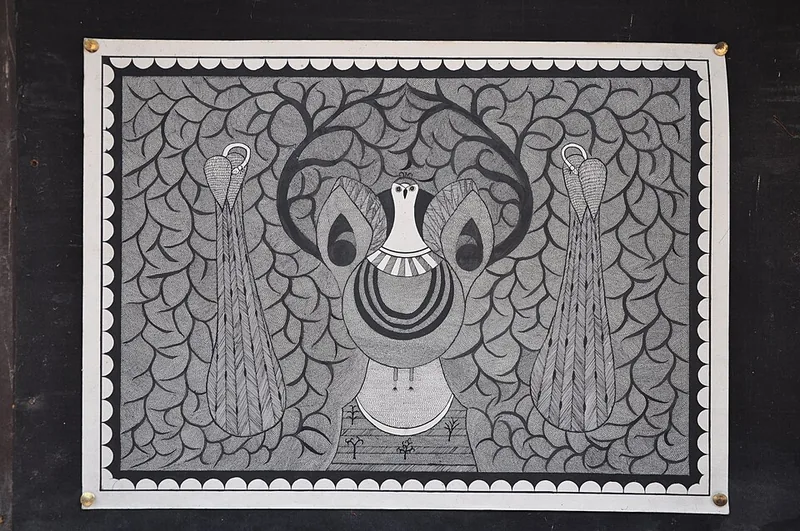
Classic Madhubani — the characteristic double-line border, the saturated colour, the refusal to leave any surface empty. Image: Wikimedia Commons.
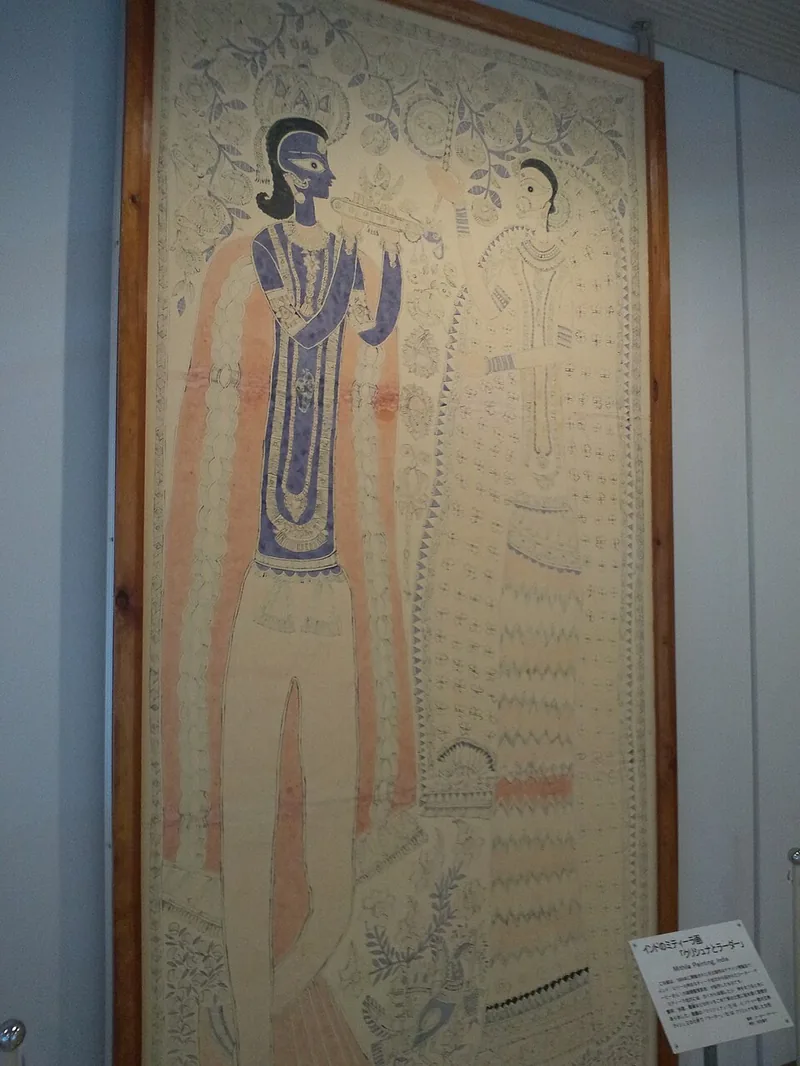
Krishna and Radha in the Madhubani tradition — intimate, tender, surrounded by the garden of devotion. Image: Wikimedia Commons.
The second great turning point came in the 1960s, when a severe drought devastated Mithila. The All India Handicrafts Board, seeking to provide the women of the region with a source of income, encouraged them to transfer their wall paintings onto paper and cloth — surfaces that could be sold. The transition was not seamless. Painting on paper demanded different handling: the surface absorbed pigment differently, the scale changed, the relationship between painter and image shifted from communal ritual to individual expression. But the women adapted, as they always had, and the paintings that emerged on paper retained the visual intensity, the sacred geometry, the narrative richness of the originals. What had been private became public. What had been ephemeral became permanent. What had been ritual became, additionally, commerce — and the tension between those two functions has defined the art form ever since.
The greatest names in Madhubani painting belong to women whose work transcended every category that might contain it. Sita Devi, who received the Padma Shri in 1981, painted with a monumental grandeur that turned a sheet of handmade paper into a temple wall. Jagdamba Devi, also a Padma Shri recipient, developed a narrative complexity in her Ramayana cycles that scholars have compared to manuscript illumination. Ganga Devi, perhaps the most radical of all, took the kohbar tradition and expanded it into a personal visual diary — painting her journey to a cancer hospital in America, her impressions of New York City, her reflections on mortality, all in the unmistakable Madhubani idiom. She proved that tradition is not a cage. It is a language, and like any language, it can say anything.
“The line in Madhubani is never hesitant. It knows where it is going because the hand that draws it has drawn it a thousand times before — and so has the hand before that, and the hand before that.”
Today, Madhubani painting holds a Geographical Indication tag, granted in 2007, protecting its name and provenance. The Indian government has painted entire railway stations, most notably Madhubani station itself, in the traditional style — a gesture of recognition that doubled as a surprisingly effective anti-littering measure, since the beauty of the painted walls discouraged vandalism. The art appears on saris, on home furnishings, on the fuselages of aircraft. It has entered the global market and, with that entry, faces the eternal dilemma of every living tradition: how to grow without diluting, how to sell without surrendering, how to remain sacred while becoming commercial.
The answer, as always, lies with the makers. In the villages of Jitwarpur, Ranti, and Rashidpur — the heartland of Mithila painting — women still sit on the floor with handmade paper spread before them, grinding their own pigments from turmeric and soot and flower petals, drawing freehand without pencil marks or preliminary sketches, guided by a visual memory so deep it operates below conscious thought. They paint because their mothers painted. They paint because the walls of the kohbar ghar must be painted before the bride arrives. They paint because, in Mithila, to paint is to participate in the order of the world — to fill the void, to complete the pattern, to ensure that the cosmos does not, for want of a single line, fall apart.
At Morassa, we honour the women of Mithila by bringing their work to you as it was made — by hand, with earth pigments, in the tradition that stretches back to the age of the Ramayana. Each piece we curate carries the specific hand of the specific woman who painted it: her rhythm, her pressure, her inherited vocabulary of symbol and line. In a world that has learned to copy everything, the one thing that cannot be copied is the knowledge in a hand that has painted since childhood. That is what you hold when you hold a Madhubani painting from Morassa.
Be among the first to own an authentic Madhubani painting, created by the women artists of Bihar’s Mithila region.
Join the Waitlist