Textiles · Kashmir · 6 min read
The Goat That Clothed Emperors: Kashmir's Pashmina
At 14,000 feet, an animal sheds its winter coat. What follows is six months of a master weaver's life.
At 14,000 feet, an animal sheds its winter coat. What follows is six months of a master weaver's life.
There is a plateau in Ladakh, at an altitude where the air is too thin to breathe comfortably and the temperature falls to minus forty degrees in winter, where a small, rough-looking goat called the Changthangi carries, pressed close to its skin beneath a coarser outer coat, one of the most extraordinary natural fibres ever woven into cloth. Each winter, the goat produces it to survive. Each spring, the nomadic Changpa herders comb it out by hand. And each of those fibres — twelve to sixteen microns in diameter, thinner than a strand of human hair, softer than anything that has ever touched your skin — begins its long journey toward becoming Pashmina.
The word Pashmina comes from the Persian pashm, meaning wool. But to call it wool is to call a Stradivarius a violin — technically accurate and completely inadequate. A single Changthangi goat yields, in a good year, between eighty and one hundred and twenty grams of raw fibre. A shawl requires the fleece of at least three goats. The finest weaves — the celebrated shahtoosh style, now restricted by law — could require many more. This scarcity is not manufactured. It is geological. The fibre exists only at this altitude, on this plateau, in this cold.
"A single Pashmina shawl requires the fleece of three goats, the hands of a spinner for weeks, and six months of a master weaver's life. It is not a product. It is a commitment."
In the workshops of Srinagar's old city, the raw fibre arrives already cleaned and de-haired — a process so labour-intensive it is almost its own craft. A master spinner, working on a traditional yinder wheel, draws the fibres into a yarn so fine it is nearly invisible. The spinning alone can take weeks for a single shawl's worth of yarn. Then the weaving begins — on a handloom, with a shuttle passed by hand between threads so delicate that the weaver must work in a slightly humid room to prevent static electricity from disturbing the warp.
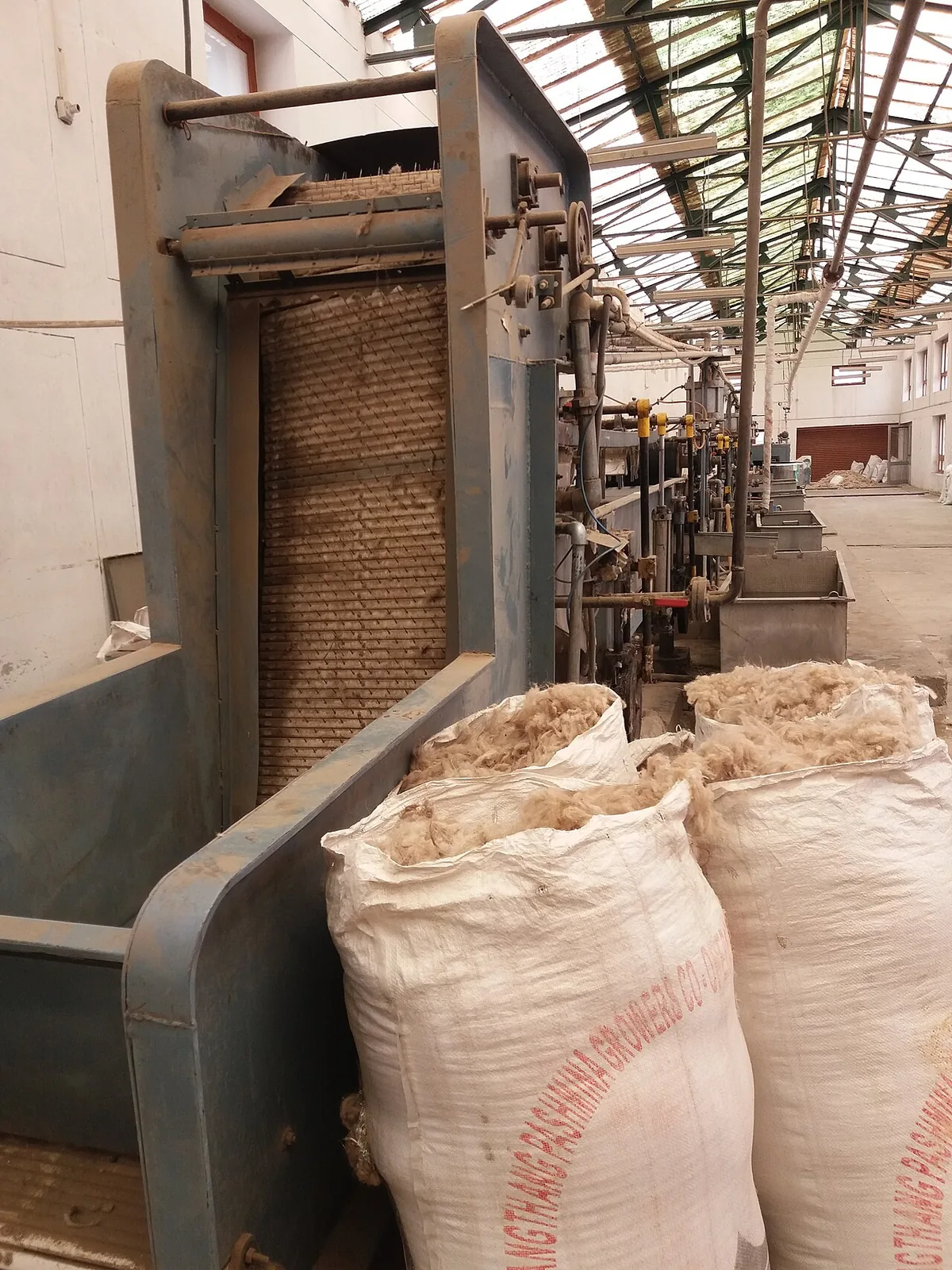
Raw Pashmina fibre from the Changthangi goat — gathered at 14,000 feet, combed by hand, finer than a human hair. Image: Wikimedia Commons.
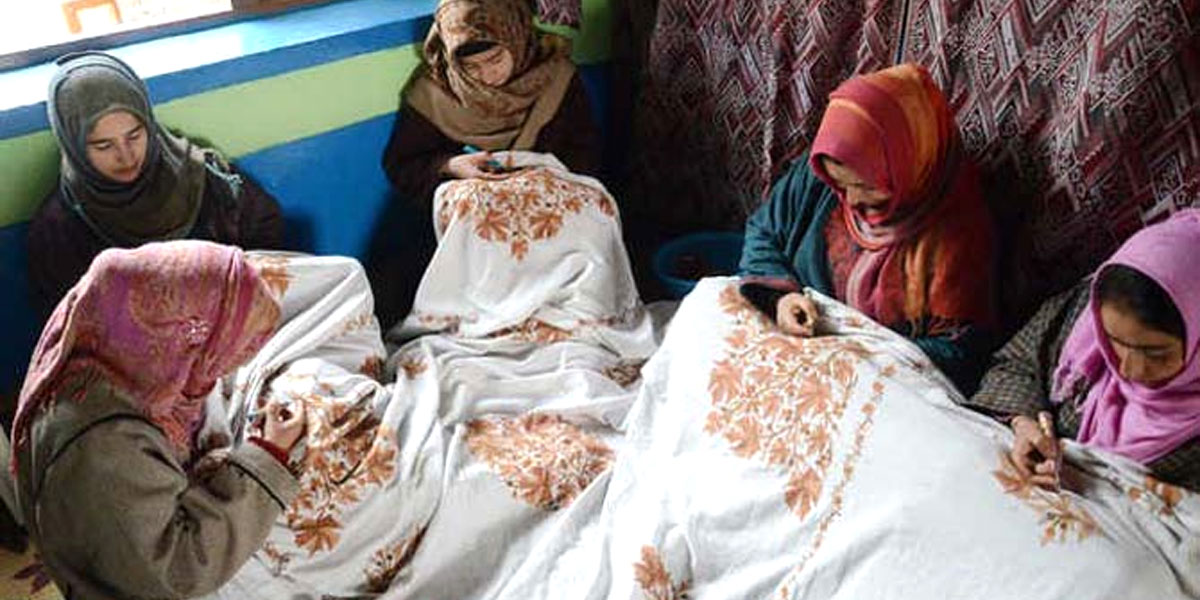
A plain-woven Pashmina shawl — no embellishment, no embroidery, just the weave itself — takes a skilled craftsman three to four weeks to complete on a handloom. Add kani weaving, where different coloured threads are woven in using small wooden bobbins to create intricate patterns, and the timeline extends to six months for a single shawl. Add sozni embroidery — needle-drawn flowers and paisley in silk on the finished weave — and you are looking at a year or more of a master artisan's life embedded in a single object.
The Mughal emperors understood this. Akbar is said to have owned a thousand Pashmina shawls, catalogued in his royal inventory by weight, pattern, and provenance. His son Jahangir sent them as diplomatic gifts to the courts of Europe, where they arrived like dispatches from another civilisation — objects so improbable in their fineness that European weavers spent decades trying to replicate them and failed. The Jacquard loom was partially developed in France as an attempt to mechanically approximate the kani patterns of Kashmir. The attempt produced something beautiful. It did not produce Pashmina.
"The Mughal emperors sent Pashmina to the courts of Europe as diplomatic gifts. European weavers spent decades trying to copy it. They never could."
Today, the genuine article is vanishingly rare — not because the tradition has died, but because the market has been flooded with imitations. Machine-woven acrylic sold as Pashmina. Merino blends labelled as pure. The confusion is deliberate and profitable for those who trade in it. The test is simple, for those who know it: hold the shawl in your hands and scrunch it into a ball. Pure Pashmina will fit in your closed fist and spring back without a crease. Pull a thread from the edge and burn it — it will smell of singed hair and leave a crushable ash. A synthetic will melt and leave a hard bead. These are not tests of luxury. They are tests of truth.
Morassa sources Pashmina directly from master weavers in Srinagar — families who have practiced the craft across generations, who can tell you the altitude at which a given batch of fibre was gathered, and who finish every piece by hand. To wear Pashmina sourced this way is to carry three goats, one plateau, one spinner, one weaver, and six months of concentrated human attention — all folded into something that weighs less than a breath.
Be among the first to receive genuine Pashmina, traced directly to the Changthangi plateau of Ladakh.
Join the Waitlist