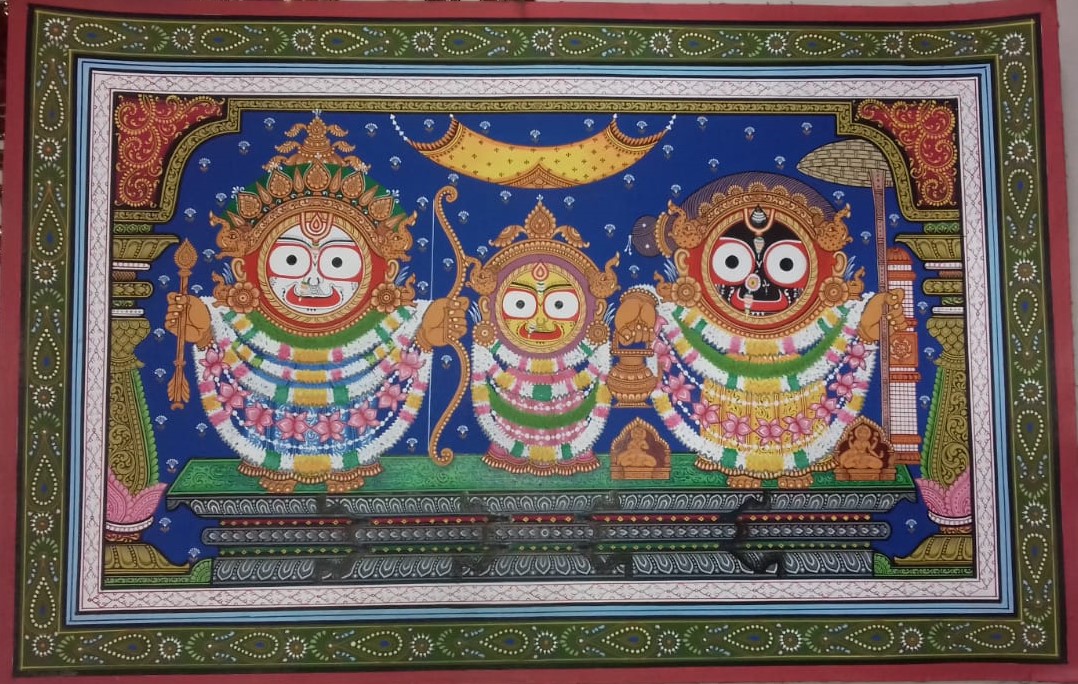
Painting · Odisha · 5 min read
The Temple Scroll: Pattachitra and the Gods of Odisha
Twelve centuries of devotion, ground into pigment and pressed into cloth.
Twelve centuries of devotion, ground into pigment and pressed into cloth.
Every Pattachitra begins not with a brush but with a prayer. The chitrakars — the painter-families of Raghurajpur village, outside Puri — are not artists in the Western sense of autonomous creators. They are, by their own understanding, servants of the deity. Their paintings do not represent Lord Jagannath. According to the tradition in which they work, the paintings are Jagannath — a legitimate form of the god, as real and present as the idol in the great temple three kilometres away. To paint is to perform a sacred act. The brush is a form of worship.
The word Pattachitra combines two Sanskrit roots: patta (cloth or scroll) and chitra (picture or image). The tradition is believed to date to at least the twelfth century, connected to the Jagannath temple at Puri — one of the four sacred dhams of Hinduism. The paintings originally served a liturgical function: when the main idol of the temple was taken for its ceremonial bath during the Snana Yatra festival and sequestered for fifteen days while being repainted, devotees who could not see the god were shown Pattachitra images instead. The paintings were not substitutes. They were the real thing.
"The painters of Raghurajpur do not represent the god. They believe the painting itself is the god — a legitimate, living form of Jagannath pressed into cloth."
The process of making Pattachitra is itself an act of extraordinary patience. The canvas — called patta — is prepared by hand from layers of cotton cloth glued together with tamarind paste and white stone powder, then dried in the sun and polished with a smooth stone until the surface achieves the consistency of fine vellum. No commercial canvas. No prepared board. Everything made from scratch, by the same hands that will paint on it.
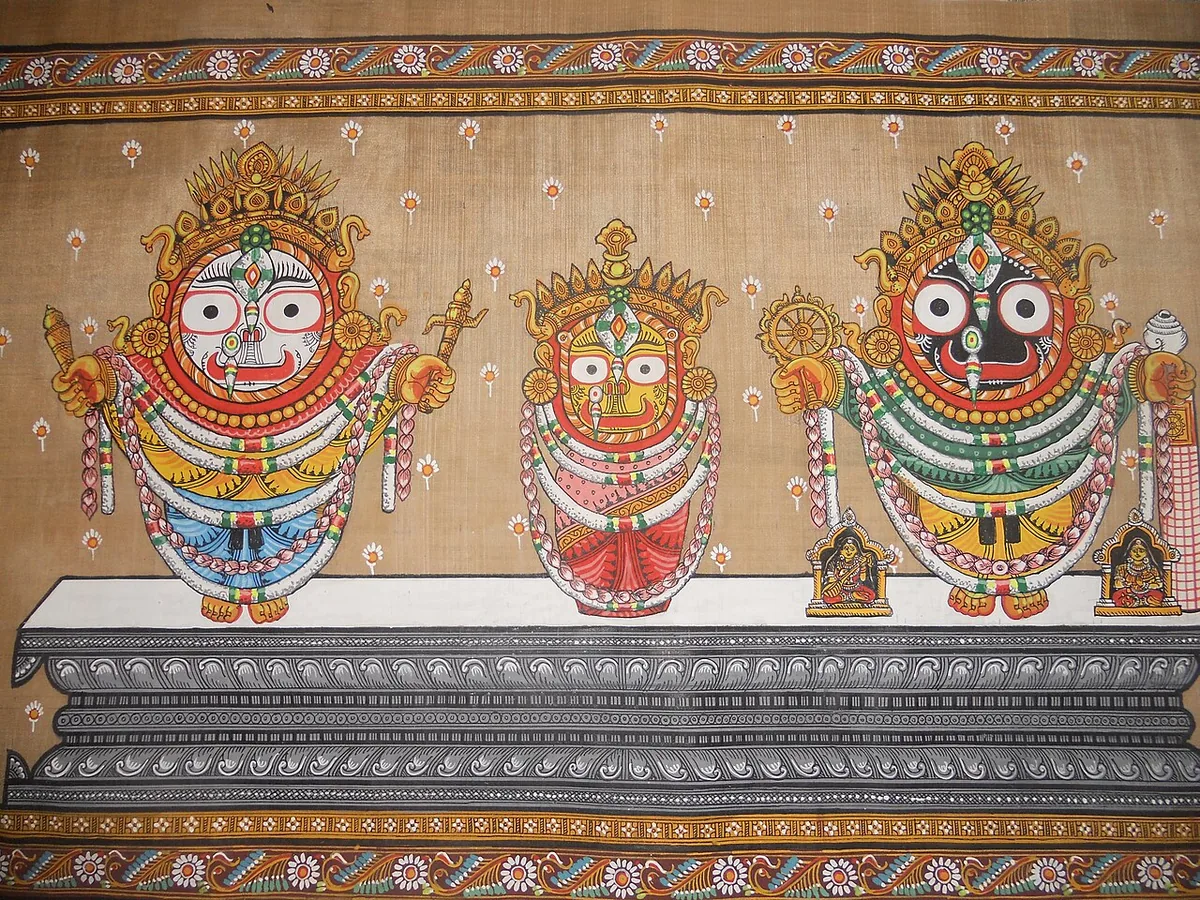
A Pattachitra from Raghurajpur village, Odisha — the border of flowering creepers marks the sacred space within. Image: Wikimedia Commons.
The pigments are ground from natural sources: white from conch shells, red from hingula (red mercury sulphide), yellow from haritala (orpiment stone), black from the burnt husks of coconut shells, blue from indigo. Each colour must be prepared fresh, mixed with a natural adhesive made from the gum of a local tree. Synthetic paints are rejected not on principle but on tradition — the old pigments carry a depth and luminosity that no manufactured colour achieves. When a Pattachitra painted three hundred years ago is held under the right light, the colours still burn.
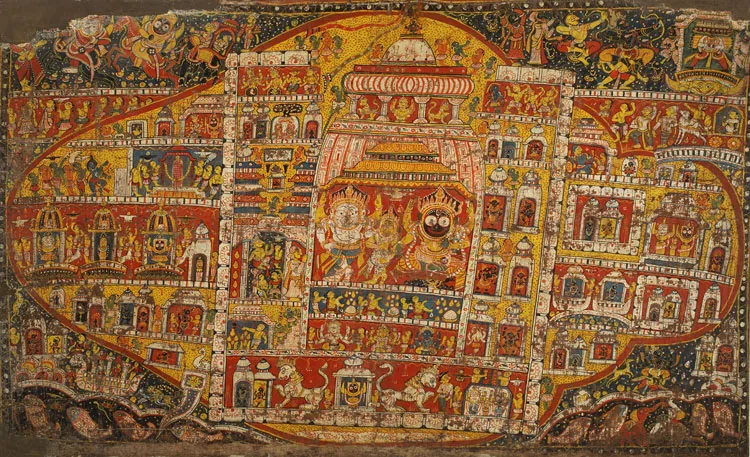
The compositions are prescribed by tradition, not invented by the artist. The forms of Jagannath, Balabhadra, and Subhadra — the three principal deities of Puri — are drawn in a stylised manner that has remained consistent for centuries: large round eyes, no ears, vestigial arms. The palette of surrounding figures, the arrangement of the border creepers, the presence of specific narrative elements — all follow a grammar that the chitrakar learns over a lifetime of apprenticeship, beginning in childhood. Innovation within this tradition is subtle and hard-earned. The freedom is not in what you depict but in how precisely, how beautifully, how devotedly you depict it.
"The colours of a three-hundred-year-old Pattachitra still burn under the right light. No manufactured pigment has ever equalled them."
In a world saturated with images produced at industrial speed for industrial consumption, Pattachitra is a rebuke and an invitation simultaneously. It insists that some things cannot be hurried. That the act of making is inseparable from the act of meaning. That an object can carry the spiritual weight of a civilisation if the hands that made it understood what they were doing and why. To bring a Pattachitra into your home is not merely to acquire a beautiful object. It is to admit something sacred into your domestic space — something that has been prayed over, prepared over days, and painted with the concentrated attention of a tradition twelve centuries old.
Morassa sources Pattachitra directly from the chitrakar families of Raghurajpur — the village where the tradition has been continuously practiced without interruption. We do not source from markets or middlemen. Each piece in our collection comes with knowledge of the hand that made it and the family that has been making such things for generations.
Own a Pattachitra from Raghurajpur — twelve centuries of devotion, translated into your living space.
Join the Waitlist